GAINS: Gaussian-based Inverse Rendering from Sparse Multi-View Captures

ECCV 2026

1University of Kaiserslautern-Landau, 2German Research Center for Artificial Intelligence,
3University of North Carolina at Chapel Hill, 4College of William & Mary

Abstract

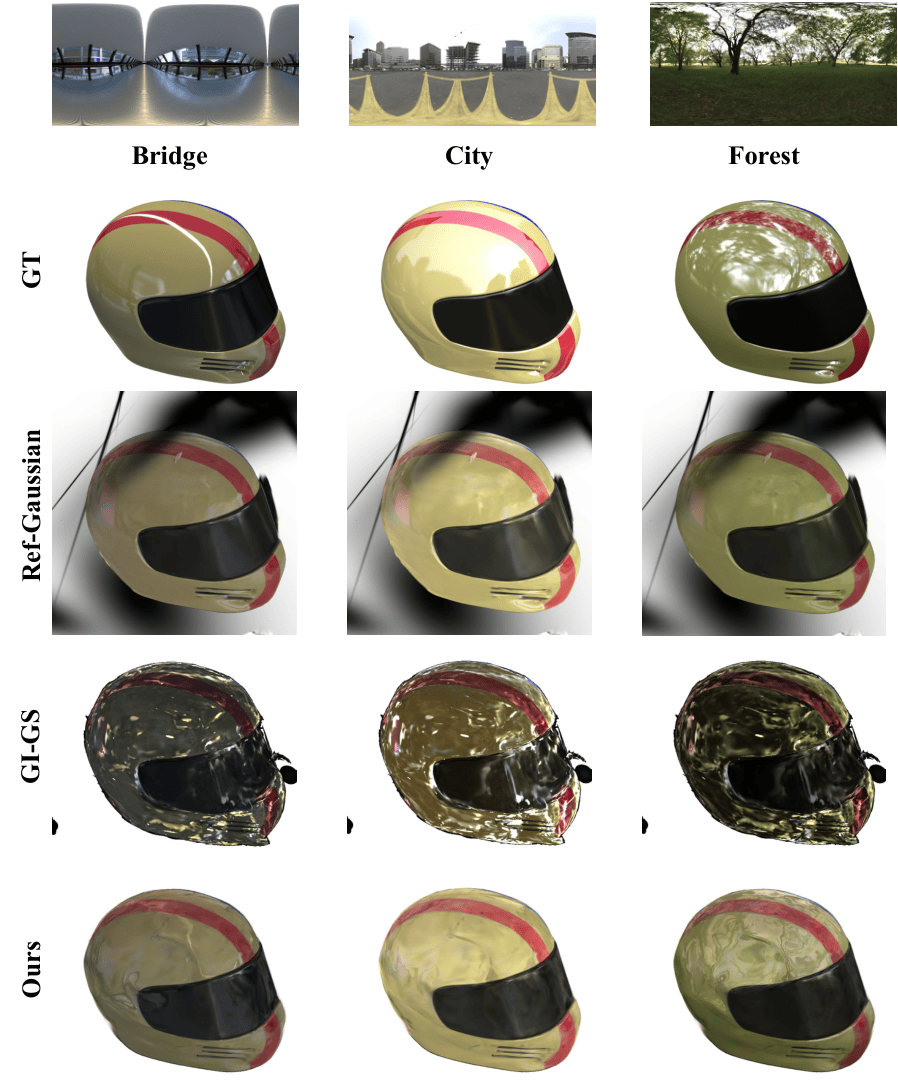
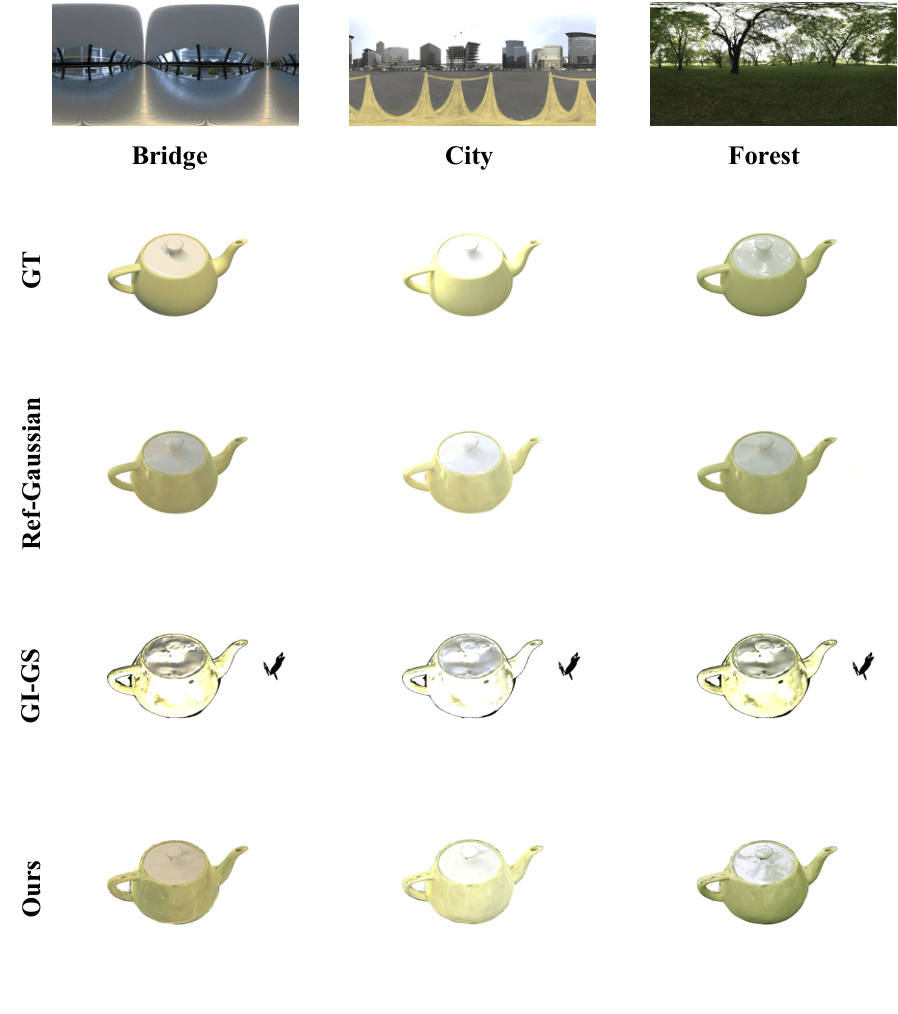
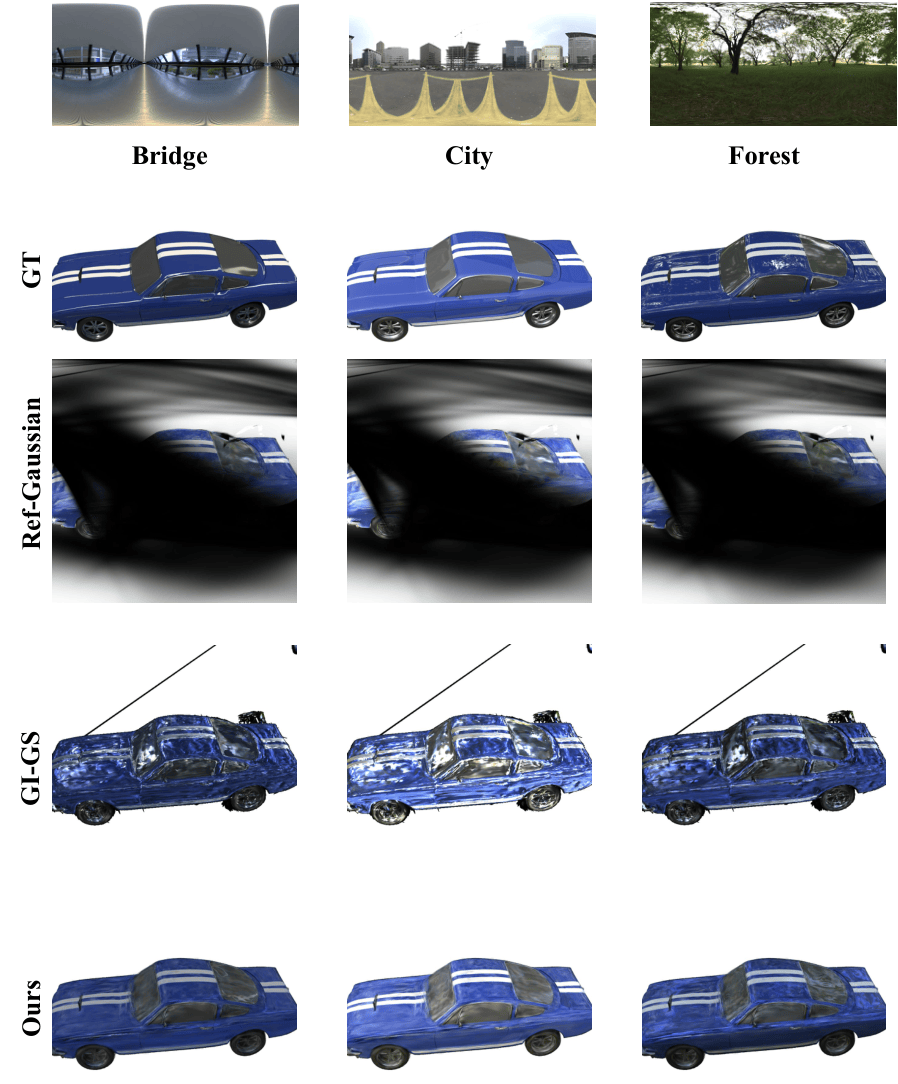
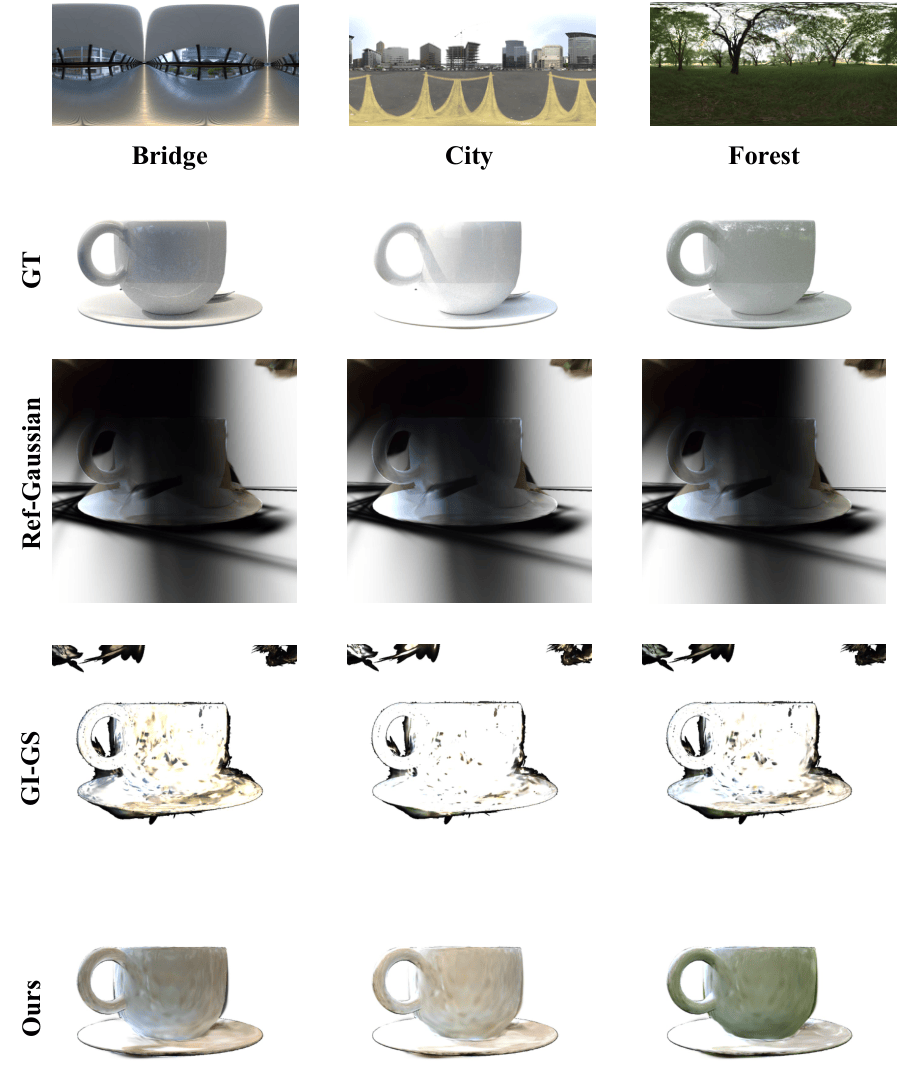
Recent advances in Gaussian Splatting-based inverse rendering extend Gaussian primitives with shading parameters and physically grounded light transport, enabling high-quality material recovery from dense multi-view captures. However, the accuracy of these methods degrades under sparse-view settings, where limited observations lead to severe ambiguity between geometry, reflectance, and lighting. We introduce GAINS (Gaussian-based Inverse rendering from Sparse multi-view captures), a two-stage inverse rendering framework that leverages foundation models as priors to stabilize geometry and material estimation. The core technical contribution of this paper is an inverse rendering framework that unifies foundation model priors with physically-based representations in an optimization scheme. GAINS first refines geometry using monocular depth, normal, and diffusion priors, and then employs segmentation, intrinsic image decomposition (IID), and diffusion priors to regularize material recovery. Extensive experiments on synthetic and real-world datasets show that GAINS significantly improves material parameter accuracy, relighting quality, and novel-view synthesis compared to state-of-the-art Gaussian-based inverse rendering methods. While GAINS outperforms and remains competitive across a wide range of objects captured with 4 to 32 cameras, the improvement is particularly pronounced under sparse-view settings, where ambiguity is high and learning-based priors become especially beneficial.
Method

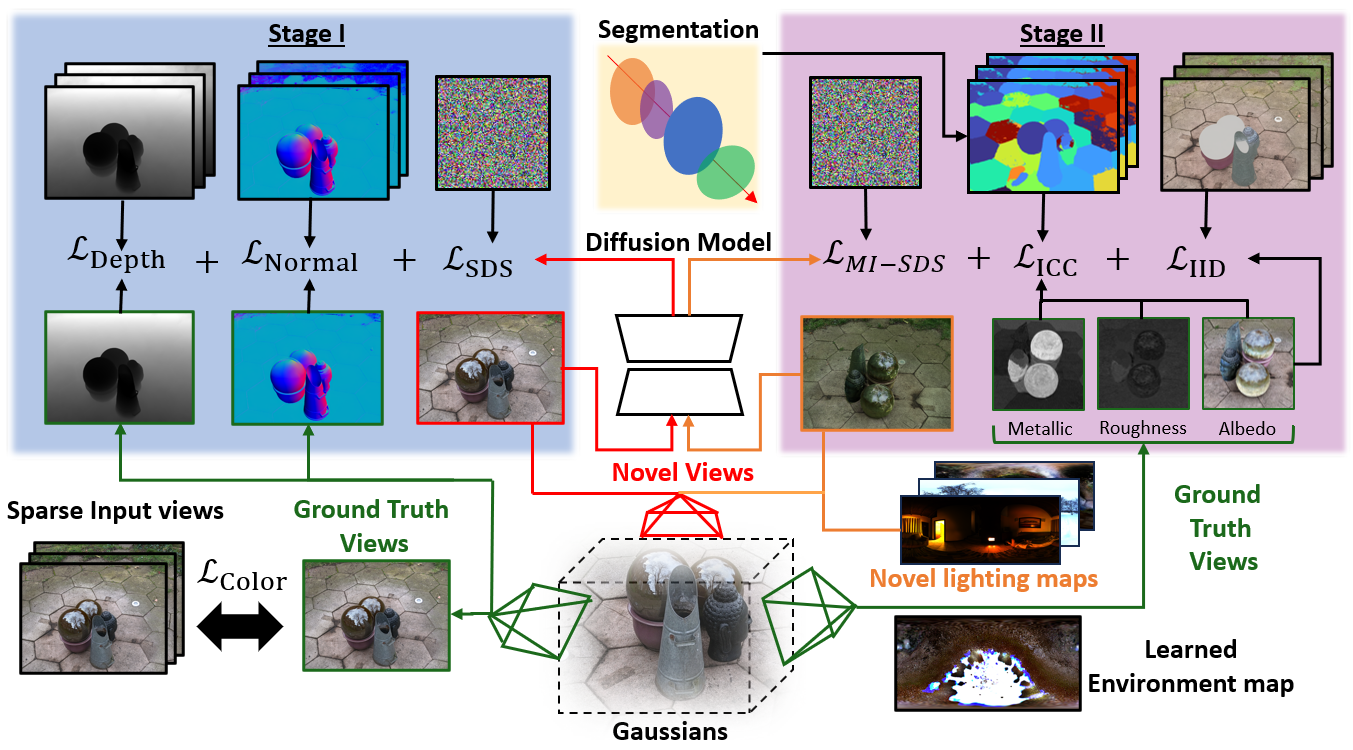
GAINS method pipeline
  • We introduce GAINS, a Gaussian-splatting-based inverse rendering framework for sparse multi-view inputs on both objects and scenes.
  • We first recover geometry using priors from monocular depth, normals, and latent diffusion.
  • GAINS then estimates materials and lighting using three complementary priors: segmentation guidance, intrinsic image decomposition, and latent diffusion.
  • Combining these priors enables robust material recovery, consistent lighting estimation, and stable novel-view synthesis and relighting under challenging sparse-view conditions.

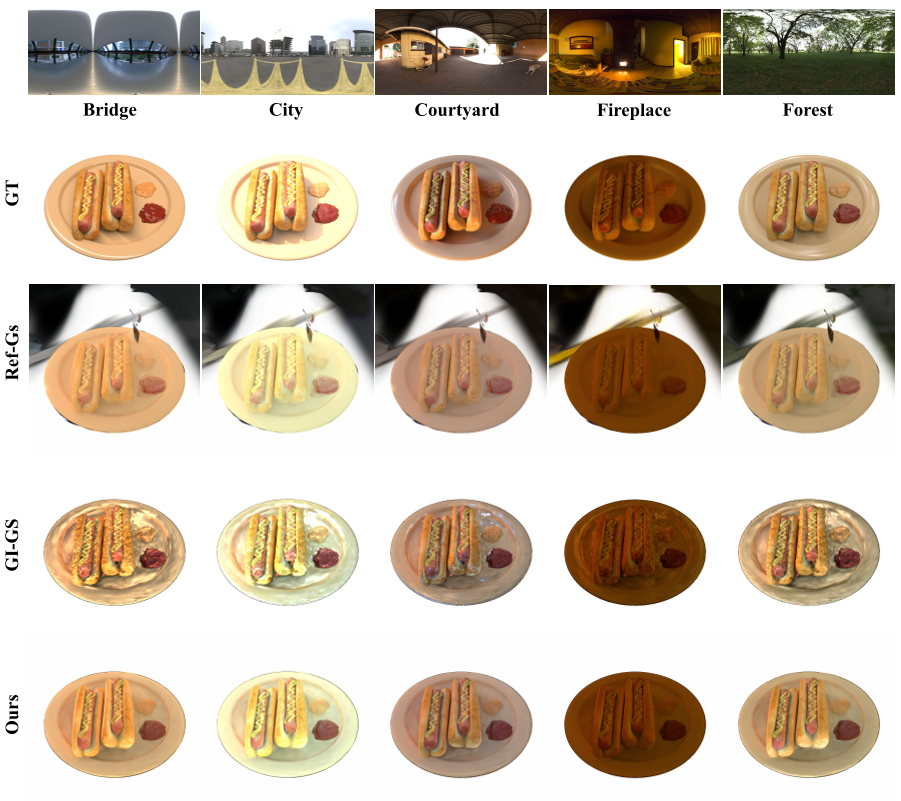
Qualitative Comparison

Ref-Real (8 input views)

Gardenspheres

Ref-Gaussian
GAINS (Ours)
GI-GS
GAINS (Ours)

Toycar

Ref-Gaussian
GAINS (Ours)
GI-GS
GAINS (Ours)

Sedan

Ref-Gaussian
GAINS (Ours)
GI-GS
GAINS (Ours)

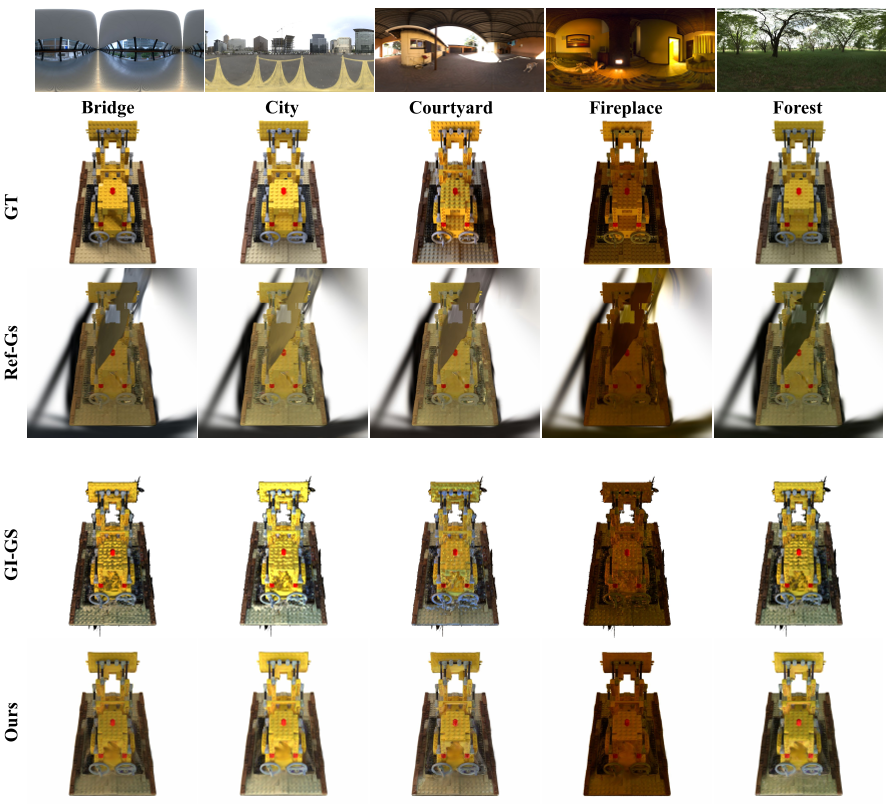
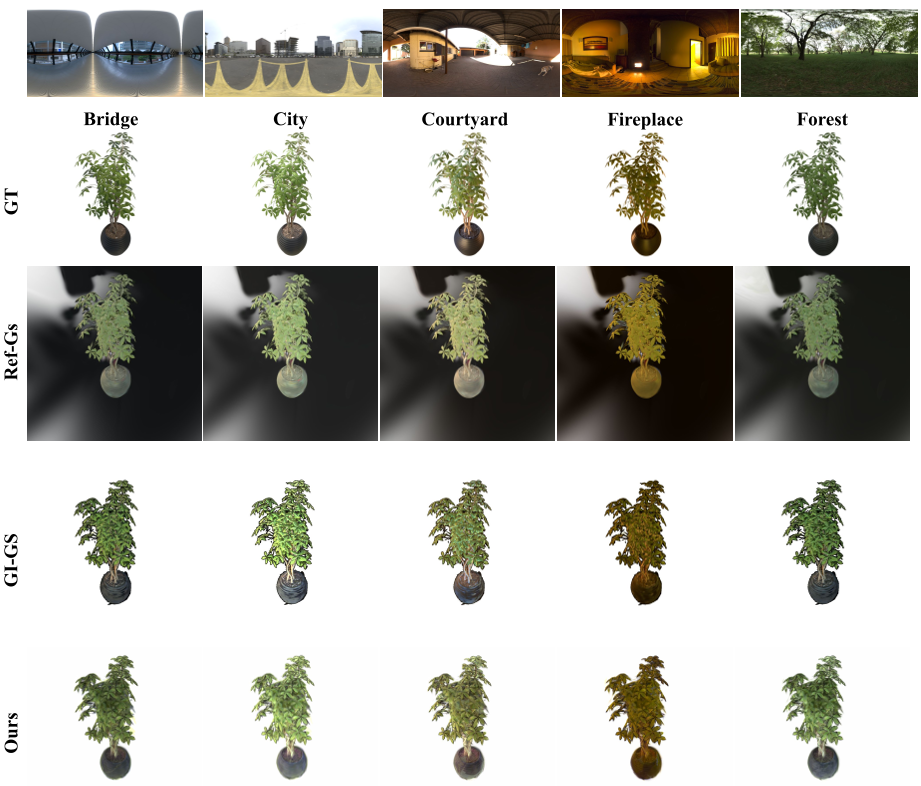
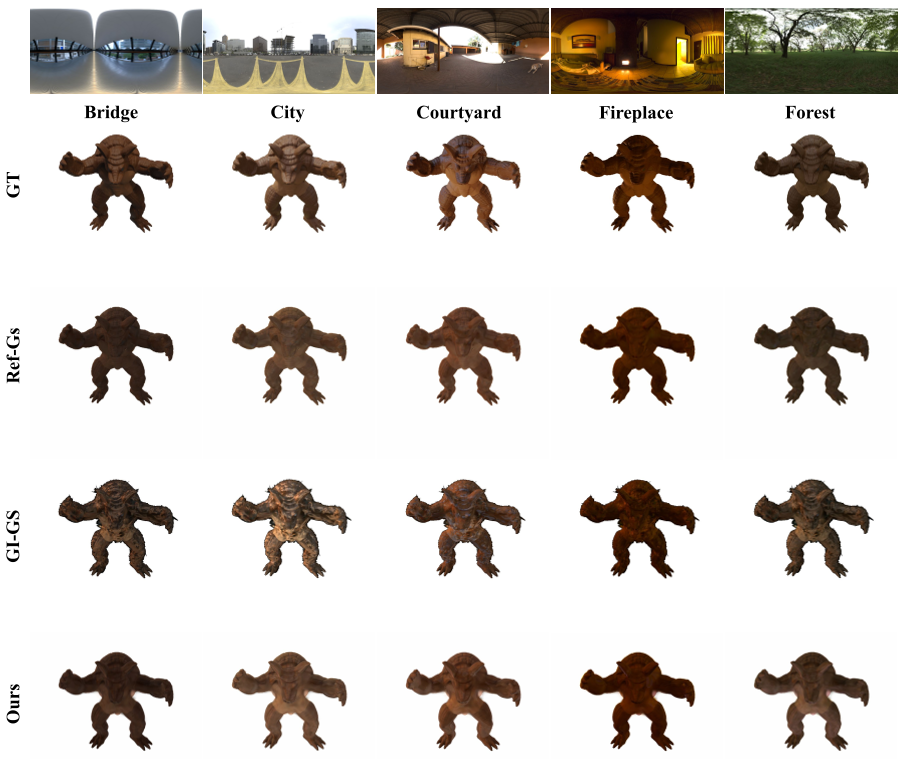
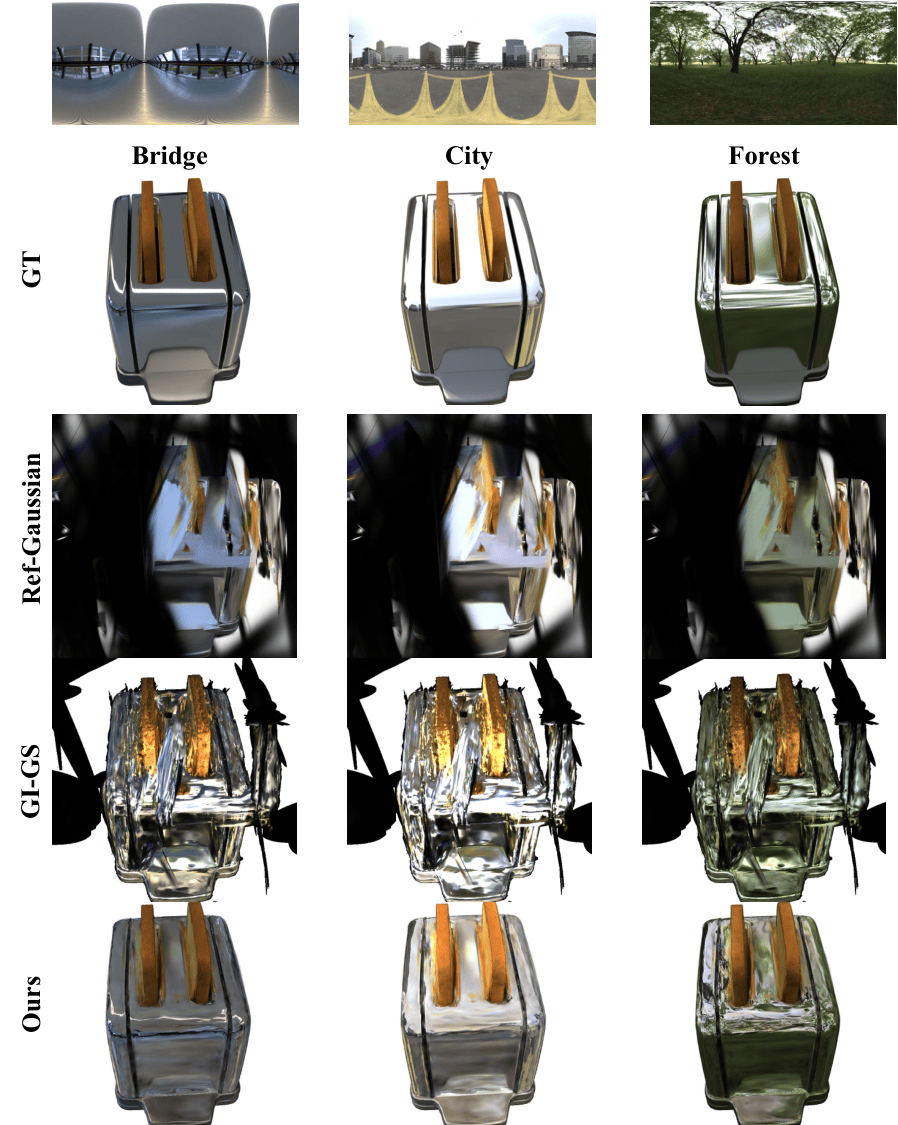
More Relighting Results

tensorIR (8 views)

BibTeX

@misc{noras2025gainsgaussianbasedinverserendering,
      title={GAINS: Gaussian-based Inverse Rendering from Sparse Multi-View Captures}, 
      author={Patrick Noras and Jun Myeong Choi and Didier Stricker and Pieter Peers and Roni Sengupta},
      year={2025},
      eprint={2512.09925},
      archivePrefix={arXiv},
      primaryClass={cs.CV},
      url={https://arxiv.org/abs/2512.09925}, 
}